
⚖️Disclosure: MyVivaVitality is a participant in the Amazon Services LLC Associates Program, an affiliate advertising program. If you buy something through a link on this page we may earn a small commission, at no extra cost to you. It never changes which scale we recommend — our pick is one of the simplest on the list.
Switching from cups to a scale is the single biggest upgrade most home bakers can make. A cup of flour can weigh anywhere from about 120 to 150 grams depending on how you scoop it. A scale doesn’t care how you scoop.
But once you’re weighing, there’s a second question most people never ask: how precise does the scale need to be? The answer depends on what you’re weighing, and it’s the difference between a loaf that rises the same way every time and one that doesn’t.
This guide compares four scales, and one kind of scale to leave behind.
| Scale | Reads in | Capacity | Best for | The catch |
|---|---|---|---|---|
| Escali PrimoOur pick | 1 g | 5 kg | Everyday baking and cooking | A big bowl can hide the display |
| OXO Good Grips 11 lb | 1 g | 5 kg | Big bowls (pull-out display) | Takes more space |
| My Weigh KD-8000 | 1 g | 8 kg | Big-batch bread, baker’s percentages | More than casual bakers need |
| Hario V60 Drip Scale | 0.1 g | 2 kg | Yeast, salt, spices, coffee | Too small for a bowl of dough |
| Dial kitchen scale | Several g | Varies | Nothing a baker needs | Hard to read, drifts |
Every digital scale here reads in 1-gram steps except one. That one is the add-on for small amounts, not a replacement.
The small ingredients are where precision matters
Most kitchen scales read in 1-gram steps. For big ingredients, that’s plenty. For small ones, it isn’t.
Take a basic loaf of bread: 500 grams of flour, 350 grams of water, 10 grams of salt and 3 grams of instant yeast. A scale that can be off by a gram either way means:
- Flour: 1 gram out of 500 is 0.2%. You’d never notice.
- Water: 1 gram out of 350 is about 0.3%. Same.
- Salt: 1 gram out of 10 is 10%. Noticeable in the taste.
- Yeast: 1 gram out of 3 is about 33%. That’s the difference between a dough that doubles on schedule and one that doesn’t.
For flour and water, a 1-gram scale is already overkill. For the yeast, the same gram is a third of the whole amount.
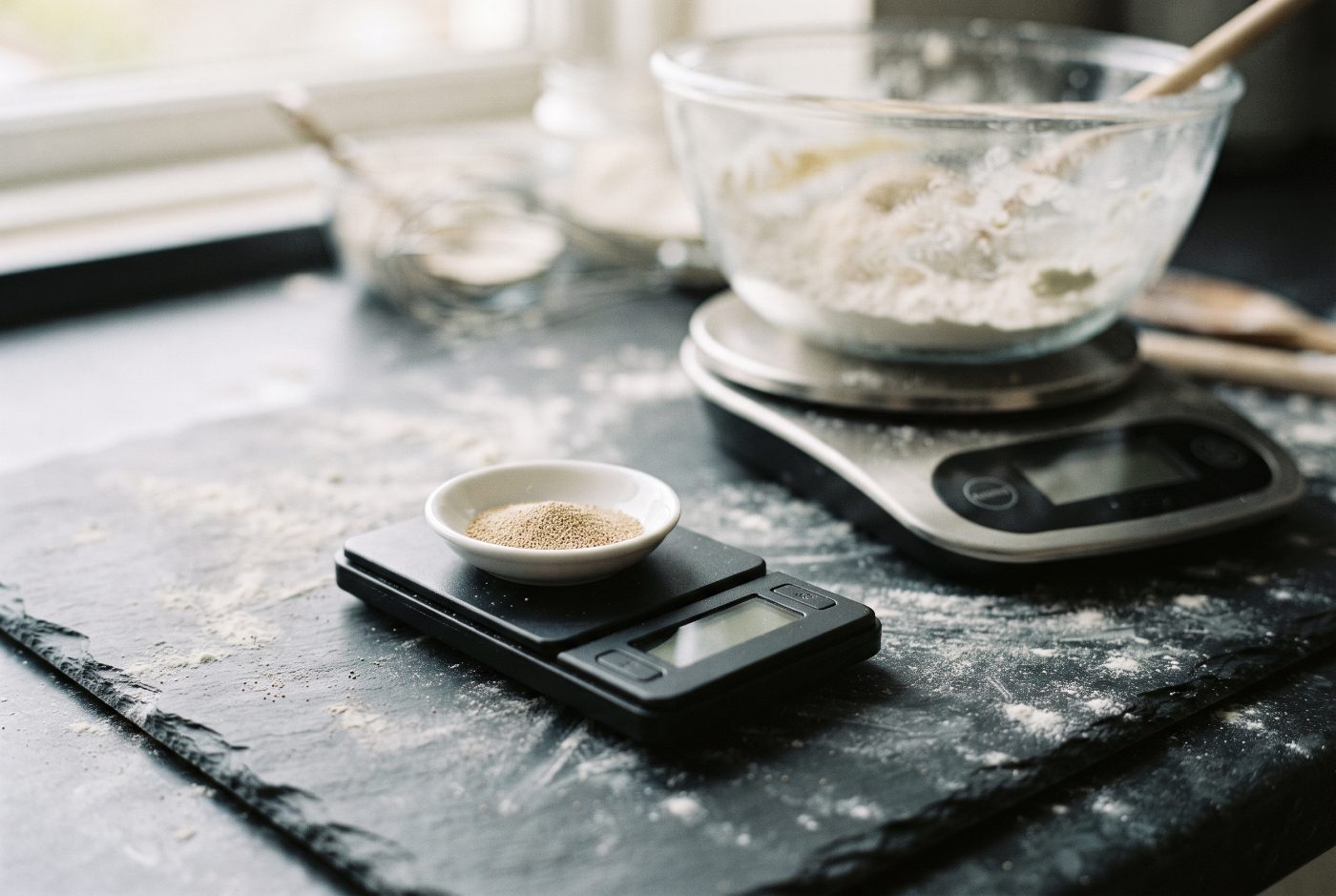
A scale that reads in 0.1-gram steps cuts all of those by ten. That doesn’t matter for the flour, but it matters a lot for the yeast.
So the practical answer for most bakers is one of two setups: a good 1-gram kitchen scale for everything, or a 1-gram scale plus a small 0.1-gram scale for yeast, salt and spices.
What else to look for
- Capacity. 5 kilograms (11 pounds) is enough for almost any home recipe. Bread bakers who mix big batches in heavy bowls may want more.
- A tare button. It zeroes the scale with the bowl on it, so you can add each ingredient in turn. Every scale here has one.
- A display you can see. A big bowl can hide the display. That’s a real problem, and one scale here solves it.
Amazon pricing moves constantly, so check the current figure before you buy. Here are the four, and the one to skip.
Escali Primo Digital Kitchen Scale
Our pick for most bakersThis is the one I’d buy for most bakers.
- Right for
- Everyday baking and cooking. It reads in 1-gram steps up to 5 kilograms, it’s small enough to store in a drawer, and it’s simple: two buttons, tare and units.
- Skip it if
- You regularly use very wide bowls. The display sits under the edge of the platform, and a big bowl can cover it.
- The drawback
- 1-gram steps, so for yeast and salt you’re at the mercy of the rounding. Pair it with a 0.1-gram scale if that matters to you.
OXO Good Grips 11 lb Food Scale with Pull-Out Display
For big bowlsThis is the pick if you bake with big bowls.
- Right for
- Bakers who mix in large bowls or sheet pans. The display pulls out from the base on a short arm, so you can read it no matter what’s sitting on top. It reads in 1-gram steps up to 11 pounds (5 kilograms), with a stainless steel platform that wipes clean.
- Skip it if
- Counter and drawer space are tight. It’s larger than the Escali.
- The drawback
- Still 1-gram steps, like the Escali. The pull-out display is what you’re paying for.
My Weigh KD-8000
For big-batch breadThis is the pick for serious bread bakers.
- Right for
- Bakers who work in big batches and use baker’s percentages. It reads in 1-gram steps up to 8 kilograms, more than the others here, and it has a baker’s percentage mode that does the ratio math for you. The display covers are removable, which helps with flour everywhere.
- Skip it if
- You bake a few times a month. Most of what it does, you won’t use.
- The drawback
- It’s bigger and more complicated than a casual baker needs, and it still reads in 1-gram steps.
Hario V60 Drip Scale
The 0.1-gram companionThis is the small-amounts companion.
- Right for
- Weighing yeast, salt, spices and coffee. It reads in 0.1-gram steps, ten times finer than the others, and it has a built-in timer that coffee brewers use for pour-overs.
- Skip it if
- You want one scale for everything. It tops out at 2 kilograms, which is too little for a bowl of dough.
- The drawback
- It’s a second scale on the counter. For most people it’s an add-on, not a replacement.
The dial kitchen scale
Leave it behind- Right for
- Nothing a baker needs.
- Skip it if
- You’re buying a scale to bake more consistently.
- The drawback
- Spring dial scales are hard to read to the nearest few grams, let alone one. They drift as the spring wears, and most don’t zero with a bowl on them. You’ve traded measuring cups for another kind of guess.
What most people get wrong
They keep measuring yeast in teaspoons. If you’ve switched to a scale, weigh the small things too. That’s where the scale helps most.
They buy for capacity they’ll never use. 5 kilograms is plenty for almost everyone. Precision is the better thing to spend on.
They forget the tare button. Put the bowl on, press tare, add the flour, press tare, add the water. One bowl, no math.
They leave the batteries in forever. A weak battery can make readings drift. If a scale starts acting strange, change the batteries before you blame the scale.
Here’s what I’d pick
For most bakers, get the Escali Primo. It reads in 1-gram steps up to 5 kilograms, it’s simple, and it fits in a drawer.
If you use big bowls, the OXO’s pull-out display is worth it. If you bake bread in big batches, the My Weigh KD-8000 does the percentage math for you.
And if your bread is inconsistent even on a scale, add the Hario for the yeast and salt. It’s the simplest way to make the small ingredients as reliable as the big ones.