⚖️Disclosure: MyVivaVitality is a participant in the Amazon Services LLC Associates Program, an affiliate advertising program. If you buy something through a link on this page we may earn a small commission, at no extra cost to you. It never changes which drill we recommend — the kit with the most pieces is the one we tell you to skip.
Every home eventually needs a drill. A shelf to hang, a bookcase to assemble, a curtain rod, a loose cabinet hinge. You can borrow one for a while, but sooner or later you’ll want your own.
The drill aisle doesn’t make it easy. There are 12-volt drills and 20-volt drills, drill/drivers and hammer drills and impact drivers, “kits” and “tool only,” and boxes with 200 pieces in them. Most of that doesn’t matter for a first drill. A few things do.
This guide compares three drills that are good first drills, and one kind of kit to skip.
| Drill | Voltage | Batteries in the kit | Best for | The catch |
|---|---|---|---|---|
| DEWALT DCD771C2Our pick | 20V | 2 | One drill for everything | Not the lightest 20V |
| BLACK+DECKER LD120VA | 20V | 1 | Occasional jobs | One battery, light duty |
| Bosch PS31-2A | 12V | 2 | Small jobs, small hands | Less power |
| 200-piece “home tool kit” | Usually 12V | Usually 1 | A gift box | The drill is an afterthought |
Both 20V drills can do the same jobs. The difference is batteries and how long they last in regular use.
12V or 20V: match the drill to the jobs
The voltage is roughly how much work the drill can do before it runs out of muscle. Here’s how the common household jobs line up:
- Hanging pictures, curtain rods and shelves in drywall: any drill will do.
- Assembling flat-pack furniture: any drill, on a low clutch setting so you don’t strip the screws.
- Tightening cabinet hinges and door hardware: any drill. A small, light one is easier in tight spots.
- Drilling into wood studs and driving long screws: a 20V drill does this comfortably. A 12V can, but slowly, and it may struggle with big screws.
- Drilling into brick or concrete: you need a hammer drill with masonry bits. A standard drill/driver will barely scratch it.
A 20V drill/driver covers every row but the last. That’s why it’s the right first drill for most homes.
For a first drill, a 20V drill/driver covers almost everything a home throws at it. A 12V is lighter and handier for small jobs, and a good choice if you’ll never do more than hang things and build furniture.
Get the kit, not the “tool only”
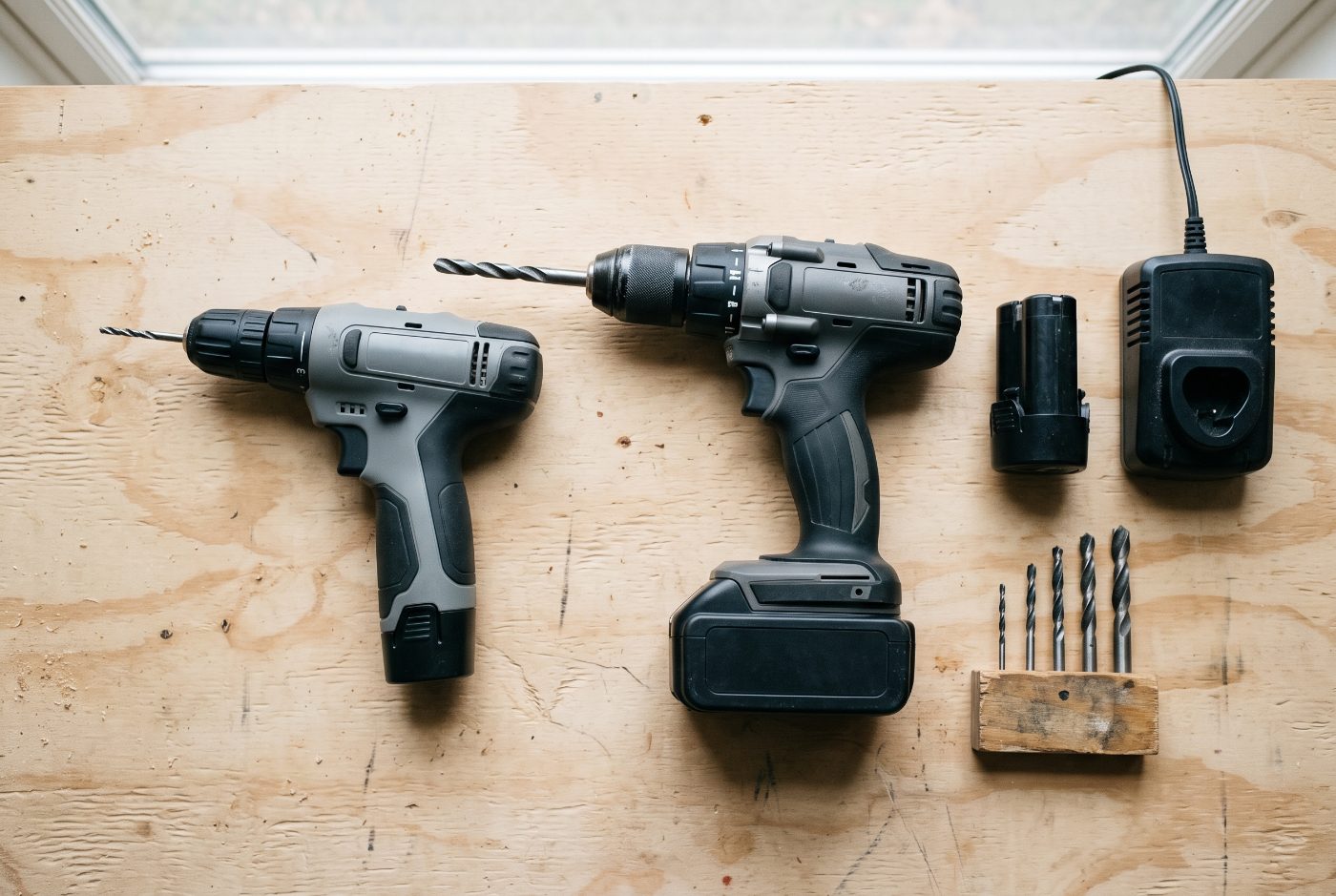
Cordless drills are sold two ways: as a kit with a battery and charger, or “tool only” without them. The tool-only version looks much cheaper, but it’s meant for people who already own that brand’s batteries. For a first drill, always buy the kit. Two batteries is better than one, so you can charge one while you use the other.
Amazon pricing moves constantly, so check the current figure before you buy. Here are the three, and the one to skip.
DEWALT 20V MAX Cordless Drill/Driver Kit (DCD771C2)
Our pick for a first drillThis is the one I’d buy for a first drill.
- Right for
- Someone who wants one drill that handles everything from flat-pack furniture to long screws into studs. The kit includes two batteries, a charger and a bag. It has two speeds (up to 450 rpm for driving screws, up to 1,500 rpm for drilling holes), and DEWALT’s 20V MAX batteries fit a huge range of other tools if you add more later.
- Skip it if
- You only ever hang pictures and build furniture. It’s more drill than those jobs need, and heavier than a 12V.
- The drawback
- It’s a basic brushed-motor drill, not the brand’s newest. For a first drill that’s fine, but it isn’t the lightest or most compact 20V you can buy.
BLACK+DECKER 20V MAX Cordless Drill (LD120VA)
The budget pickThis is the budget pick.
- Right for
- Occasional jobs around the home. It comes with a battery, a charger and a 30-piece bit set, so it’s ready to use out of the box.
- Skip it if
- You’ll use it often, or on tougher jobs like long screws into studs. It’s built for light duty.
- The drawback
- One battery, and less power and durability than the DEWALT. When the battery dies halfway through a job, you wait.
Bosch PS31-2A 12V Max Drill/Driver Kit
For small jobs and small handsThis is the pick for small jobs and small hands.
- Right for
- Apartment dwellers, furniture assembly, and anyone who finds a full-size drill heavy. Bosch lists the drill at 1.8 pounds, and it’s compact enough for inside cabinets. The kit includes two batteries and a charger.
- Skip it if
- You’ll drill into studs or drive long screws often. That’s 20V work.
- The drawback
- Less power. For anything bigger than hanging and assembling, you’ll feel the limit.
The 200-piece “home tool kit with drill”
Skip it- Right for
- Someone who wants a box of assorted tools as a gift, and doesn’t mind what’s in it.
- Skip it if
- You want a drill that lasts.
- The drawback
- These kits put most of the money into the piece count: dozens of tiny bits, clamps and wrenches you’ll rarely use. The drill at the center is usually a no-name 12V with a small battery and a weak clutch. You’d do better with a proper drill and a small bit set.
What most people get wrong
They buy the “tool only” by mistake. Check the listing says battery and charger included.
They drive screws at full speed. Use the low speed setting and the clutch. The numbered ring behind the chuck stops the drill before it strips the screw or cracks the wood.
They use the wrong bit. Wood, metal and masonry need different drill bits. A wood bit on a brick wall just gets hot.
They buy a hammer drill for drywall. Unless you’ll be drilling into brick or concrete, a hammer drill is extra weight and noise for nothing.
Here’s what I’d pick
For a first drill, get the DEWALT 20V MAX kit. Two batteries, two speeds, and enough power for every common job in a home, plus a battery system you can grow into.
If you’ll only ever hang things and build furniture, the Bosch 12V is lighter and easier to handle. If you use a drill a few times a year, the BLACK+DECKER will do the job.
Whatever you buy, get the kit with the battery, and learn what the clutch ring does. It will save you a lot of stripped screws.